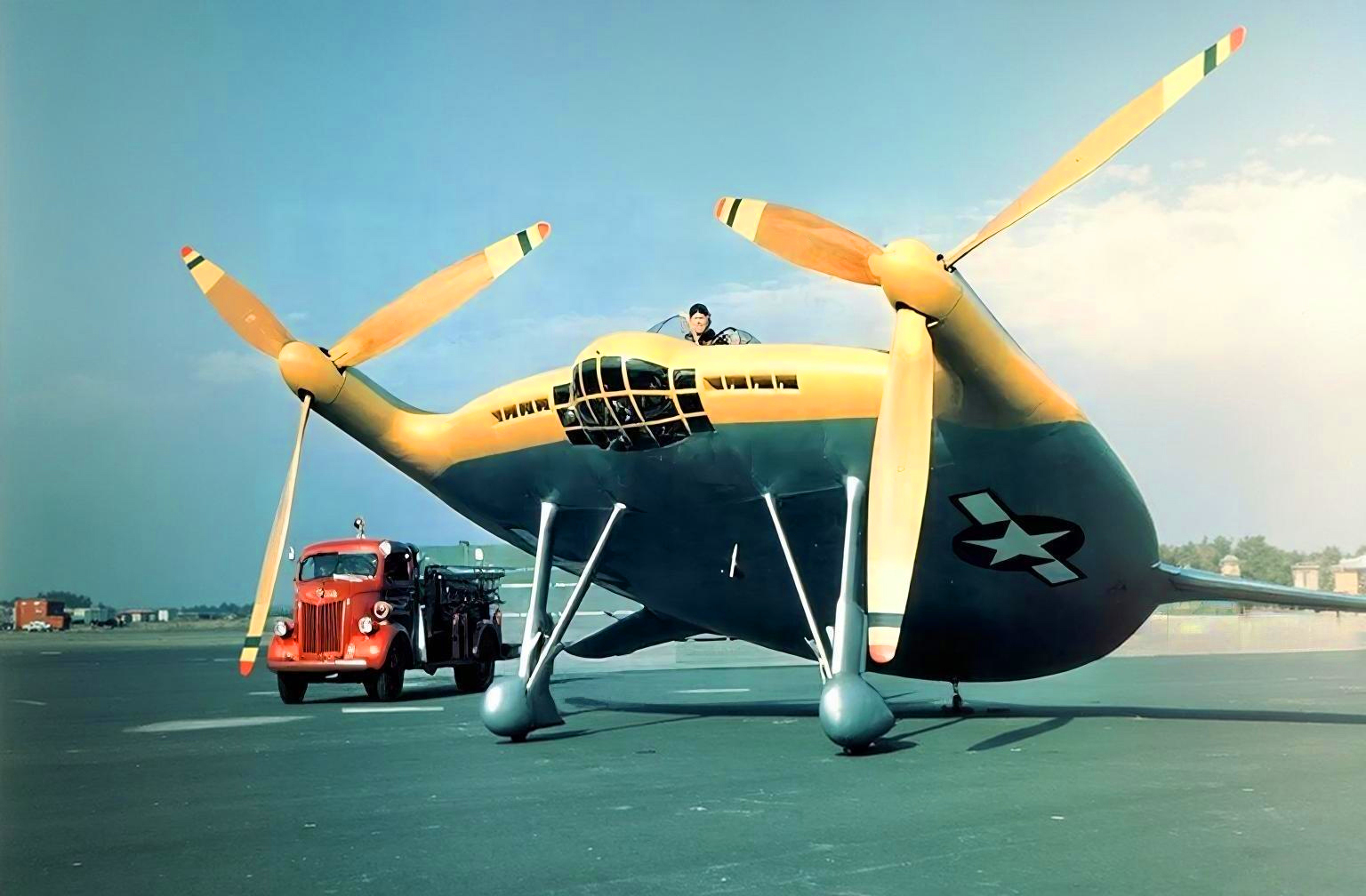
In the 1940s, as aviation evolved rapidly, engineers worldwide sought radical ways to improve flight performance. One of the boldest and visually most incredible experiments was the project known as the Vought V-173 - an experimental aircraft whose flat, disc-shaped fuselage earned it the nickname "The Flying Pancake."
The V-173 project was the brainchild of engineer Charles H. Zimmerman. His concept was based on the "All-Wing design" principle: the entire aircraft body was meant to function as a massive wing, generating maximum lift with minimal drag.
The main goal was to create a fighter capable of:
Deck Utility: Taking off and landing over very short distances, which was critically important for aircraft carriers.
Low Stall Speed: Maintaining stability at extremely low speeds, which would be invaluable for maneuvering.
The V-173 looked unlike any other aircraft of its time.
Instead of a traditional fuselage, it featured a disc-shaped, nearly circular body with the cockpit protruding from the center. Two powerful propellers were mounted on the sides of the body, rotating in opposite directions to counteract torque (the rotational force).
The two propellers were not just large; they were gigantic, occupying nearly half of the disc's surface area. This was engineered to maximize thrust at low speeds, literally "pulling" the aircraft into the air.
The experimental V-173 made its first flight in November 1942. Flight tests revealed astonishing results:
Remarkable Stability: The aircraft could fly safely at an incredibly low speed—just 32 miles per hour (about 51 km/h). This was a historically low speed for the era.
Short Takeoff: The "Pancake" could lift off the ground after a very short run.
Unique Maneuverability: The disc shape allowed for maneuvers unthinkable for conventional fighters, making it a potentially difficult adversary in combat.
However, there were also issues: the structure was heavy, and the massive propellers caused severe vibration that was dangerous for the pilots.
Despite its unique flight performance, the Vought V-173 project and its more advanced jet-powered successor, the XF5U "Flying Flapjack," were canceled in 1947.
The reason was simple and fatal:
By the end of World War II and immediately thereafter, jet engines emerged onto the scene. Jet aircraft offered unprecedented gains in speed and power, quickly rendering the entire concept of slow, propeller-driven, albeit highly maneuverable, fighters obsolete.
Today, the V-173 remains one of the strangest and most ambitious projects in aviation history, clearly demonstrating how 1940s engineers were unafraid to radically rethink the shape of an airplane in pursuit of efficiency.





 Welcome!
Comments